

Tapping Torque Test: Which Cutting Fluid for Aluminum Lubricates Best
We compared three EASYCUT coolants — a practical way to find the best cutting fluid for aluminum — by the torque it takes to form a thread. The rule for reading this test is simple: the lower the torque, the better the coolant lubricates. PRO302 needed about 7% less torque than UNI301 at about a 5% higher price. BVR301 needed about 20% less torque at about a 12% higher price.
Why lower torque means better lubrication
When a tap goes into the metal, part of the spindle's effort forms the thread. The rest is spent overcoming friction between the tool and the workpiece. The coolant affects only that friction part. A better lubricating film means less friction, so the spindle needs less torque for the same thread. Tap, material and speed stay the same, and only the fluid changes, so any difference in torque comes from the coolant.
Thread forming makes this especially clear. A forming tap doesn't cut, it pushes the material into shape, so nearly all the load goes through the lubricating film. Aluminum also tends to stick to the tool, which makes the difference between coolants even easier to see. That's why tapping torque is a standard lab measure of lubricity.
This test measures lubricity only. Cooling, sump life, foaming and corrosion protection are separate questions.
Test setup
- Operation: thread forming
- Material: aluminum
- Coolant concentration: 10%
- Spindle speed: 636 rpm
- Thread depth: 8 mm (0.31"), then reverse out
The test was run in the manufacturer's application lab. Torque was recorded along the whole depth. The average was taken over 2–8 mm, once the tap was fully engaged.
Results
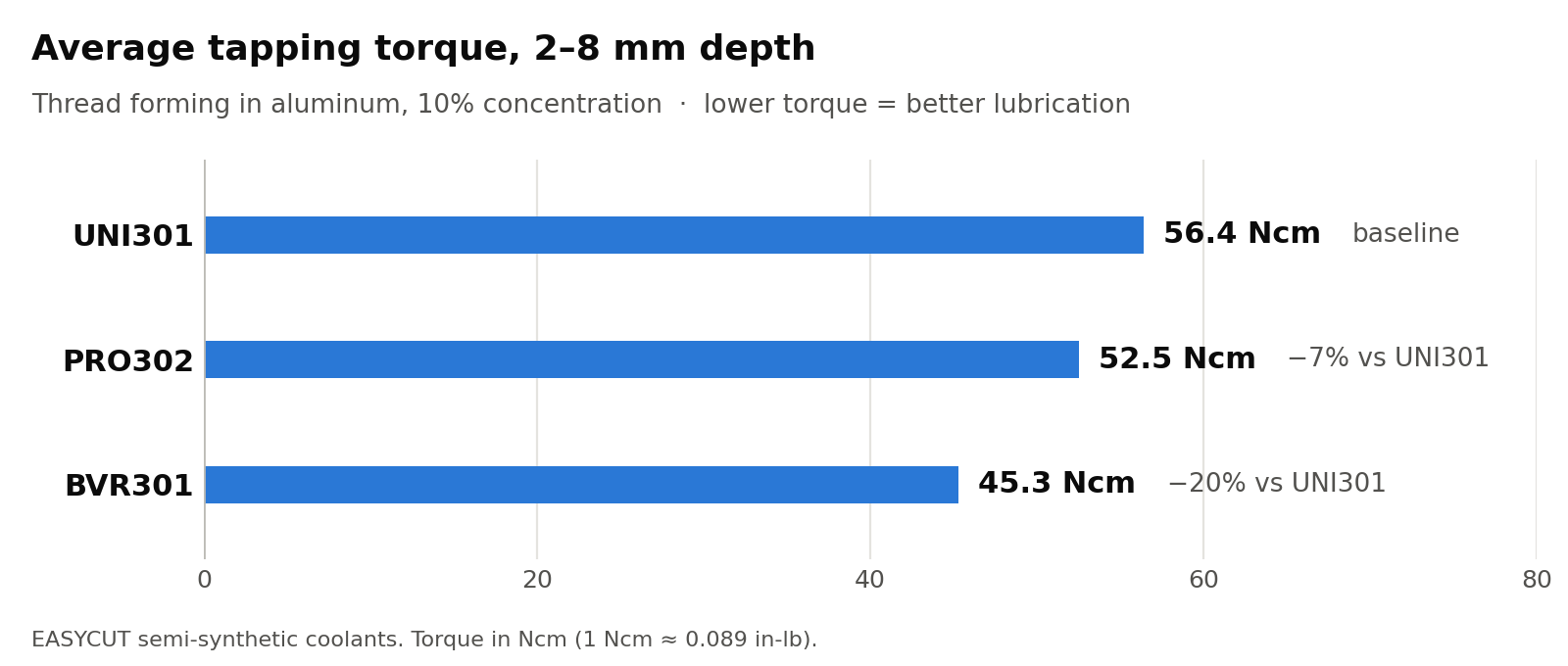
Lower torque = better lubrication.
| Tapping torque | UNI301 | PRO302 | BVR301 |
|---|---|---|---|
| Peak torque, Ncm (in-lb) | 70.0 (6.2) | 63.0 (5.6) | 58.0 (5.1) |
| Average torque 2–8 mm, Ncm (in-lb) | 56.4 (5.0) | 52.5 (4.6) | 45.3 (4.0) |
| Torque compared with UNI301 | — | −7% | −20% |
What it costs
CAD, excluding taxes. Prices as of September 2026.
| 55 gal drum (208 L) | UNI301 | PRO302 | BVR301 |
|---|---|---|---|
| Drum price | $1,653.81 | $1,736.50 | $1,847.31 |
| Per gallon of concentrate | $30.07 | $31.57 | $33.59 |
| Per gallon of coolant mixed at 10% | $3.01 | $3.16 | $3.36 |
| Price compared with UNI301 | — | +5% | +12% |
UNI301: the universal baseline
UNI301 is a semi-synthetic for steel, stainless and aluminum. It had the highest torque in this test, which is expected from a coolant built to cover a wide range of jobs rather than to get the most out of one material. For shops with mixed work, it's a solid default.
PRO302: the better buy if you cut aluminum
PRO302 costs about 5% more than UNI301. At 10% concentration, that's about 15 cents more per gallon of mixed coolant. In return, torque on aluminum drops by about 7%, and peak torque from 70 to 63 Ncm. The price difference barely shows on the invoice, while the difference in lubricity shows on every aluminum part. If aluminum is a regular part of your work — even alongside steel — PRO302 gives more for almost the same money.
BVR301: heavy machining and maximum output on aluminum
BVR301 had the lowest torque in the test: about 20% below UNI301 and 14% below PRO302. It also had the lowest peak torque and the smallest spread along the thread. It's built for heavy machining in aluminum alloys, steels, cast iron and titanium: deep cuts, high feeds, tapping and forming. On aluminum it's the choice when you push for maximum metal removal. It costs about 6% more than PRO302. That gap pays off where the cut is heavy and lubricity sets the limit on how hard you can run.
Which cutting fluid for aluminum to choose
- Mixed materials, aluminum only now and then → UNI301
- Aluminum is a regular part of your work → PRO302
- Heavy machining, or aluminum at maximum metal removal rate → BVR301
What this test does and doesn't show
This is one test: one material, one operation, one concentration. It shows lubricity under hard friction conditions very clearly. It doesn't show cooling, emulsion life in the sump, foaming or behaviour in steel. Results in your shop depend on water hardness, concentration and the tool. If you switch between these coolants, check the concentration with a refractometer after the change-over — the coolant calculator helps with the mix — and compare tool life over a few weeks.
All three coolants are available in 5 gal pails, 55 gal drums and 270 gal totes. You can order them online 24/7.